Berserk Retrospective
How I learnt to stop worrying and love Berserk.

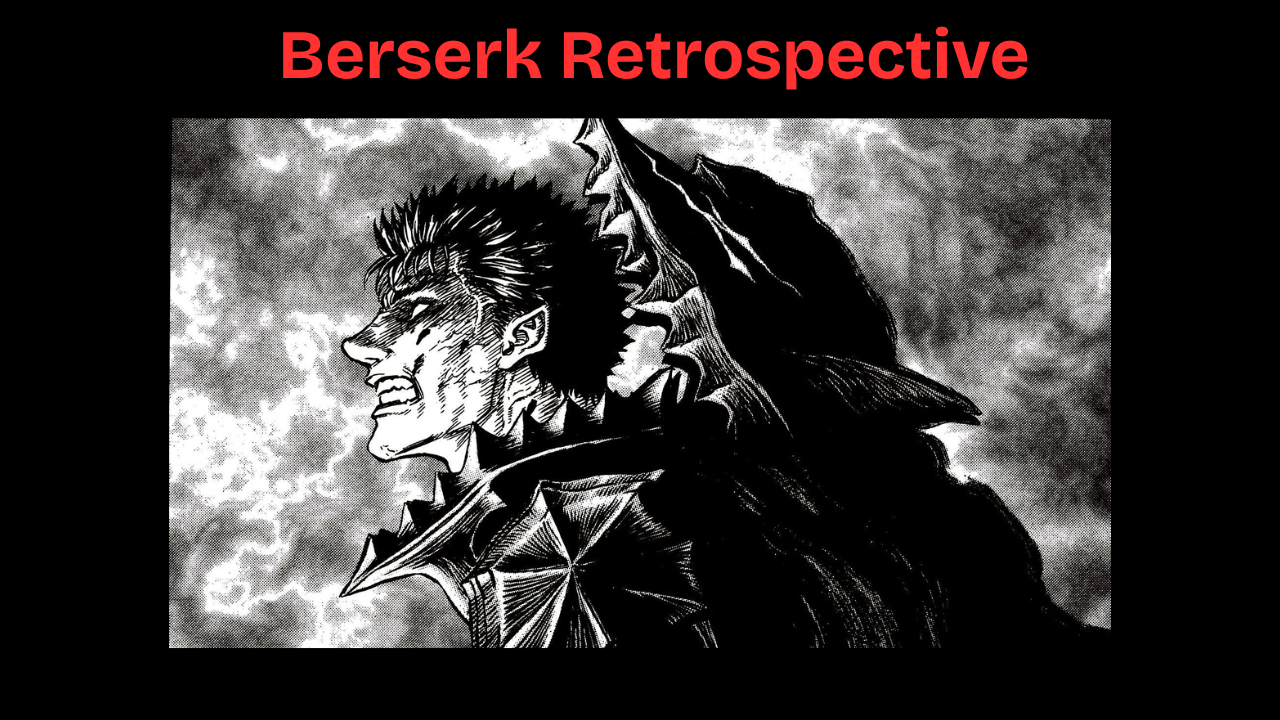
When I wanted to get into Manga, Berserk proved to be a rather costly adventure. Each deluxe volume was almost if not slightly more than a thousand rand for me. But holy hell is it an adventure. From the first panel to the last, it is an exercise in horror, hope and suffering. Struggle against the seemingly overwhelming evil of the world.
From the first panel, you see someone who has perfected their art and somehow has gotten better in their craft. Miura brings every fleeting moment of love and tenderness, or horrors only possible by imagination to life. I will never forget the moment when I discovered that the art only gets better. I was in the Black Swordsman arc, the first of the story when it happened. It was so beautiful, so evocative and then only to see the improvements in linework and the shading and the expressions in upcoming volumes. It blew my mind honestly.
Berserk, despite its ugliness of topic and themes, is an extremely beautiful Manga, amidst all the horror and suffering, there is a beautiful testament to life. The world among the darkness harbours some light, such as the moment between Guts and Casca by the waterfall. Maybe it’s the moment on Elf Island, perhaps the episodes of tenderness between Griffith and Guts, tragic as it is, all offer some semblance of humanity.
It would have been so easy for Miura to make Berserk a shock fest, a terrible series of unfortunate events that is only linked together in suffering. A grimdark orgy of death and meaningless sex would have made for a dull read, for once you have seen one fate worse than death there is not much else left.
Miura balances a delicate act of horror, drama and comedy. Comedy that, while not always perfect, is able to provide relief for the rest. I might not like Puck as a comedic character, but I do find him refreshing in such a dark world. Same with the moments of adorable awkward comedy with Casca. Miura understands the importance of tonal variety to make a readable Manga.
Great works, especially one that deal with dark subjects need some sort of emotional relief. You can get away with a bleak tone if it is compelling enough, think Blood Meridian. But often, there needs to be some sort of comedy. American Psycho’s satire provides bitter laughs at 80s Yuppie culture for example. Berserk has comedy in several forms, like with Puck and Isidro and to a lesser extent Casca before the Eclipse. It is needed to keep the numbness at bay.
Granted, that isn’t to say that there aren't other ways to keep the reader engaged, it could be tenderness between friends or loved ones such as in The Road or The Babadook. Berserk has these in spades, such as with the Moonlight Child and Casca or Schierke. Miura understood the importance of humanity in his world. People are social creatures; they can’t always be killing each other or be miserable.
No society can last so long under such unrelenting cruel conditions. Miura understood this when designing his world. He wanted to explore the horrors of man through a fantasy lens, but he knows enough about how humans operate. Even in cruel societies, there is always kindness.
Berserk has imagery that I will never forget, from the Rape Horse to the Eclipse to Ganishka’s final form. Berserk has spawned horrors that rival the likes of PTSD Radio or Uzumaki, maybe even surpassing many a horror Manga.
There is dark fantasy that is mostly edgy stuff, ironically immature in its execution because it comes from someone with a childish view of the world. They only see the blood and guts and think that is all to the horrors humanity can afflict upon our fellow man. They don’t understand the motivations, how evil manifests or how it justifies its own existence. They haven’t studied evil; they haven’t read about the real world.
Berserk, for all its fantasy nightmares, understands humanity’s vices. Griffith didn’t just do the things he did because he felt like it. But rather it was the result of his narcissistic ego being damaged by Guts’ refusal to be controlled by him. Ganishka became a monster because of his childhood and the betrayals that shaped him. His need for power caused terrible destruction upon the world at large. The God Hand as beings were all human once but were made by their willingness to sacrifice loved ones. Power, the need for and the control of it is central to the themes of Berserk.
I think that is what makes Berserk so special a Manga, so special a dark fantasy epic. It is its uncompromising willingness to explore the dark, to be unflinching in its approach towards the ways which people inflict horrors on those around them. Few works of literature dare to be so blatant, so vicious in the depiction of humanity’s worst impulses.
But Berserk, for all the darkness and the Grimdark label, wasn’t dark for darkness’s sake. But rather hopeful through it. Puck is a testament to this, same with the tender moments between Guts and Casca. Sure, the world is dark, but there is always a little bit of light within. Without light there are no shadows after all, there could be complete darkness, but you are bumping into furniture and falling over the cat.
It’s hard to do well and rarely successful even if you know what you are doing.
I was emotionally devastated multiple times by Berserk, be it from that one scene involving horses, the end of The Band of the Hawk and Ganishka’s final form. I cried towards the end, I warmed during the sweet moments.
Berserk was a rollercoaster for me, something I will never forget, I am glad I have read it all. I look forward to the end of the series. I want to read more of it, I shall continue reading as Mori finishes the legacy.
I look forward to seeing the ways Miura and Mori influence my own dark fantasy series. I am keen to spot the shades of Guts haunt The Irisian Edda in all the little ways the subconscious allows.
One of the things I love about art is the ways in which it immortalises the artist or at least keeps them going long after they are dead. As well as how great art echoes throughout the ages.
Intertextuality is one of the best things about art.
I look forward to seeing the ghost of Guts and Casca flitter in and out of the shadows of my work.
Seriously, read Berserk.
Spoiler warning
Right, I want to talk a bit about some of the scenes that really affected me throughout Berserk. I wanted to keep most of this post free of spoilers as I want to encourage people to read this Manga.
But I know that it doesn’t really provide concrete examples as to how Berserk affected me. So, I am going to give some insight.
During the whole Elf Island arc, Miura successfully lulled your good self into a blissful sense of happiness. The elf king has cured Casca, the relationship might not have completely repaired, but it had the possibility to heal. Guts had the guidance towards moving on and rejecting the Beast of Darkness's influence. This could have been a bittersweet ending for the Manga.
Then along came Griffith, again. He kidnapped Casca, again and broke Guts, again. And within a few moments, Miura ruined my evening. I felt like absolute shit after reading that part. Then I saw Guts fall into the worst, most real depression I have seen in Manga. I was devastated, for Guts especially. I was angry that Miura would have done this to Guts, getting him so close to happiness before snatching it away. Miura was able to make me feel such visceral emotional reactions, after everything I had been through; to see Griffith snatch away Casca again just broke me.
Some scenes that unnerved me was when Ganishka lowered himself into the Demon Womb and attempted to make himself into a God. The scene where he breaks out, the image of him peering out of the doors horrified me. Just like in PTSD Radio the imagery and the scenario is grossly upsetting. Ganishka’s eerie mindset towards humanity as some bastardised God is also unsettling, as he views the people being destroyed under him as mere flowers.
Other scenes involving Ganishka would be the times when he is feeding women to crocodiles, seeing them being torn apart was very disturbing for me.
I love how Schierke remains pure, even in such a dark world. She could have been worn down by the endless hardships she encounters. Miura could have had her raped or almost raped. Hell, the time when Flora kills herself could have been the moment when the innocence was ripped away.
But instead, she doesn’t, she remains maybe mature for her age, but always hopeful, always kind. That’s what I meant in the spoiler free section, she balances out the darkness in tone and visuals.
That’s why I tend to disagree with the claim that Miura was a Grimdark author, the sheer presence of Shierke and Punk tell me otherwise. If he were Grimdark they would have died or been reduced to a miserable shell of their former selves. Schierke’s resilience against the darkness, while not explicitly championed, is on full display throughout. Her strength comes not just from her magic but her ability to be kind and help people.
Miura has a lot of empathy for his characters, something that is vital for great art as nobody wants to experience something that is driven by spite and disgust. Case and point as to why this is a bad thing, look at how The Boys comic panned out and basically every Conservative comedy produced since 2016.
You see this in how Guts breaks down after losing Casca again, the depression is so terrible he doesn’t want to live. I felt so bad for him, I wanted to hug that giant of a man.
But it’s also through the Lost Children Arc where this empathy for people shines for characters like Rosine. Lost Children is his dark twisted take on Peter Pan. Rosine is a child who was abused by her father and after getting the Beherit, sacrifices her parents to become a Peter Pan like figure.
Her story and ending are tragic and makes you think about how violence only creates more suffering, the endless cycle of abuse as the poor kids never grow up and inflict suffering around them. She just wanted a childhood for herself, Jill and for the other kids. But she only created monsters.
Miura's empathy for people, especially kids; shows particularly during this arc. He knows how kids suffer in abusive households, the alluring desire to escape, to be free of growing up. He succeeds where other dark imaginings of Peter Pan fail. The surface horror is backed by the empathetic, deeply human knowledge that we make our own monsters, that we let ourselves become monsters. Sometimes we can sympathise with them, we can see how they were made and feel sorry for them.
If it worked for the Romantics, then it can work for us.
I think that should be all for me. I will be talking about Berserk more later. But I just wanted to share my thoughts on the series. I don’t really have the time to do a full deep dive into everything yet.
Seriously, go read Berserk. It's great.
Chat with you later!